 |
How not to fall into euphoria and depression during warWar is also a battle of nerves. The well-known truth concerns both the "front line" and the "rear". How to express emotions, what to do and what not to do to increase mental strength, and not to get exhausted? President of the Armenian Psychiatric Association Armen Soghoyan spoke with Anna Sargsyan.
|
 |
"The great Players" and The Artsakh WarArtsakh today is not only the focus of military operations. The "great players" of the region are trying to redraw the map of political influence. What to expect? Political scientist Alen Jondyan talked to Anna Sargsyan.
|
 |
The settlement of the Artsakh issue from the white pageToday the issue of Artsakh recognition is on the Armenian political agenda, the Madrid Principles or the Kazan document are on the agenda of the superpowers resolving the conflict. Is there a way to reconcile this contradiction in the language of non-war? Political scientist Saro Saroyan talked to Anna Sargsyan.
|
 |
Artsakh- a stage of global politics"Turkey and Great Britain want NATO to have full military control over trade between Europe and China". Their strategic task is to build a land route from the Caspian Sea to Nakhichevan, and close the region in northern Iran.The current situation is directly connected with the ongoing hostilities in Artsakh ". Sargis Tsaturyan, Editor-in-Chief of Realist International News Agency, spoke with Anna Sargsyan.
|
 |
How to gain new allies in warWhy did Turkey fail to import terrorists in Artsakh? How to work with power centers in the region? How to register the victory and fix it on a political ground? Political scientist Hayk Sahakyan had a talk with Anna Sargsyan.
|
 |
Why is the education reform lagging behind?What can existing laws or those yet to come to existence, do when the system shows resistance by means of un written rules? What are the relationships and ethics within the education system today? Who is that lags behind on the path of real reform: is it the teacher, the pedagogue, the administrator, or the government? Davit Petrosyan, a member of theinitiative “Restart”, and Vahram Soghomonyan, a member of the Educational Civic Initiative discuss the topic. The conversation is hosted by Anna Sargsyan. |
 |
Coronavirus pandemia: Advice from public health professionalsHow to self-isolate, what is the social distance, how to maintain one's own and public health in the face of the new coronavirus pandemic? Dean of the Faculty of Public Health of the American University of Armenia Varduhi Petrosyan and cardiologist Tatevik Hovakimyan discuss the topic. The conversation is hosted by Anna Sargsyan. |
 |
The cost and the price of educationWhat is the cost of public education, what is price that the state, parents and students pay for education? Social psychologist Davit Amiryan and cultural anthropologist Aghasi Tadevosyan converse about the issues of public education and the impact of public-political relations on the school. The conversation is hosted by Anna Sargsyan. |
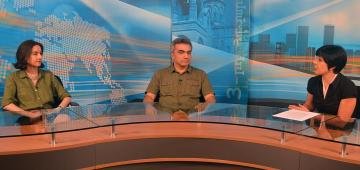 |
The Vectors of Foreign Policy of Post-Revolutionary Armenia and Inevitable Issues
What has changes in the foreign policy agenda of Armenia? Are those the vectors or the messages that have changed? Has the attitude of geopolitical centers to Armenia changed?
Expert in International Studies Anahit Shirinyan and political analyst Edgar Vardanyan discuss the topic.
The conversation is hosted by Anna Sargsyan.
|
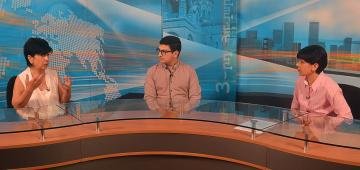 |
Media and the New Reality of Armenia
Recently, some media outlets disseminated an announcement and expressed their concerns over media activities. The announcement was addressed to the government. But the reason for the discussion was the changes in the media landscape. Are our perceptions on media changing? Is it the government to define the rules of the game in the media field? What does the public expect from the media and what the media expects from the government?
The director of "Region" Research Center Laura Baghdasaryan and media expert Harutyun Tsatryan discuss the topic.
The conversation is hosted by Anna Sargsyan.
|
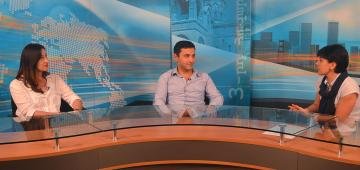 |
Expectations of the New Generation from the Velvet Revolution Outcomes
What hopes and motives did the new generation have when participating in the velvet revolution, and what expectations does the youth have from the government formed in the result of that revolution? Historians Anna Khachyan and Gor Madoyan discuss the topic.
The conversation is hosted by Anna Sargsyan.
|
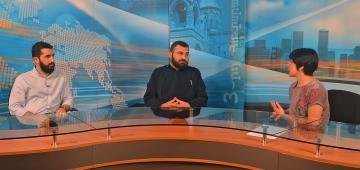 |
The Church and the Society: Old Connections and New Expectations
The Christian churches have often undergone public-political upheavals, revolts and revolutions. The Armenian Church is no exception. Church-society, church-state relations have sometimes been in solidarity, sometimes in cooperation, sometimes openly rejected. In the 20th century, the Bolshevik society, for example, burnt churches and shot priests. A few decades later, the same society, with the change of the social-political system, revealed that it is not only a follower of the church, but also the church is a key part of its identity and national wealth.
What is the status of church-society relationship in the 21st century? What does the Armenian society expect from the Armenian Church today?
Very Rev. Fr. Shahe Ananyan from the Mother See and expert in Oriental studies Varuzhan Geghamyan discuss the topic.
The conversation is hosted by Anna Sargsyan.
|