 |
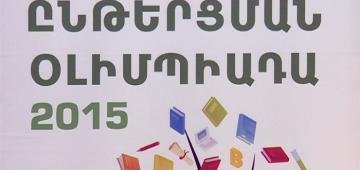
The winners of Reading Olympiad identifiedOn May 20, at the National Library, the names of first three winners of Reading Olympiad were announced. Fluent reading, right emphasis and expressiveness: these were the principles adopted by the jury in the decision-making process. The first three winners are Marine Boyajyan, Vazgen Hovhannisyan from Yerevan, Khachik Nalbandyan from Tavush Marz.
|
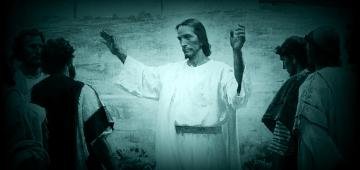 |
Gospel of Mark 6. 7-13Christ called His 12 disciples and sent them to preach giving them the power against evil spirits and He commanded them not to take anything more than a stick for the road – neither a bag, bread, money, nor a n extra rob, and only to wear slippers. And if they don’t get respective honor and acceptance, they should shake the dust off and leave. |
 |
The Minister of Culture summed-up the activities of recent monthsOn May 16, the Minister of Culture Hasmik Poghosyan summed-up the activities of recent months. She specifically stated the creation of Komitas Museum-Institute as one key achievement of the year. Among other achievements, she also mentioned the creation of electronic databases for monuments, carpets, Armenian press and Armenian book. The digitization of notes and Armenian films located in the Opera Theatre will continue. After the adoption of the Armenian Law on Museums, currently the development of the draft Law on Cinematography is underway as per the assignment of the President of Armenia, which is soon to be presented to the Government.
|
 |
Pilgrimage of the youth to Artsakh, ShushiMore than 100 young men from the Youth Centers of Ararat Patriarchal See headed to a pilgrimage to Artsakh under the guidance of Father Petros Malyan. At the dawn of May 8, the offered a victory prayer in Ghazanchetsots Cathedral of Christ the Holy Savior. |
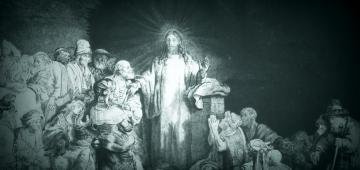 |
Gospel of Mark 6. 1-6“Jesus left there and went to his hometown, accompanied by his disciples. When the Sabbath came, he began to teach in the synagogue, and many who heard him were amazed. “Where did this man get these things?” they asked. What did Christ teach in Nazareth, why was he amazed at people’s unbelief, and why his own locals didn’t accept Him? |
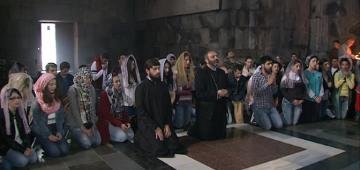 |
Pilgrimage of Conservatory students to Tatev Monastery ComplexThe students of Yerevan State Conservatory visited Tatev Monastery Complex with the support of Petros and Maral Baghdasaryans. The pilgrims were guided by Bishop Bagrat Galstanyan.
|
 |
Komitas as seen by the XX century painters: exhibition in Sargis Muradyan GalleryOn May 5, Sargis Muradyan Gallery showcased a new exhibition under its roof with it main topic focusing on the Armenian Genocide, specifically the image of Komitas.
|
 |
Gospel of Mark 5. 21-43The verses 21 through 43 in Chapter 5 of the Gospel of Mark refer to the daughter of Jairus, as well as the passages on the bleeding woman from the Gospel. Who was Jairus, how did Christ heal her? What was the reply to the bleeding woman, who came nearer to Him? Father Markos Mangasaryan provides explanations. |
 |
15th anniversary of consecrating St. Sarkis Church of Nor NorkOn May 3, the 15th anniversary of consecrating St. Sarkis Church of Nor Nork was celebrated. A festive celebration was held in Armenian Youth Center of Nork.
|
 |
Gospel of Mark 5. 1-20“Jesus came to the country of the Gadarene. When he came out of the ship, immediately there met him out of the tombs a man with an unclean spirit.”
|
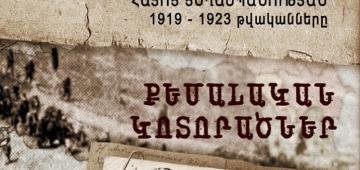 |
Armenian Genocide: Kemalist Massacres of 1919-1923The official Turkish history denies the Armenian Genocide, claiming that the Turkish Republic has nothing to do with the Genocide. The film “Kemalist Massacres” based on documentaries fully rebuts these claims. The Government of Mustafa Kemal Ataturk pursued the plans of young Turks by exterminating and displacing the Western Armenians from their historical motherland. The Kemalists filled the empties state budget on the account of the wealth that Armenians earned over centuries, paid most part of their foreign debts and on October 29, 1923 acclaimed the Republic of Turkey. Modern Turkey was built on the grounds of material, political and military values they appropriated during the Armenian Genocide.
|
 |
Gospel of Mark 4. 35-41“That day when evening came, he said to his disciples, “Let us go over to the other side.” Leaving the crowd behind, they took him along, just as he was, in the boat. There were also other boats with him. A furious squall came up, and the waves broke over the boat, so that it was nearly swamped. Jesus was in the stern, sleeping on a cushion.”
|