 |
New strategy of education and science. part 211With Professor Michelle Kyulhandjian of Rice University in Houston, Hovhannes Yeranyan discussed the activities of ASOF, the association of Armenian scientists, programs to support science and education in Armenia, and the results of the scientific conference held in Dilijan on June 25-28. |
 |
Day of the Covenant at the Holy Mother of God Church in Aragats
The Holy Mother of God Church in the Aragats village of the Aragatsotn Diocese celebrated the 12th anniversary of the re-consecration of the sanctuary by the Primate of the Diocese, Bishop Mkrtich Proshyan, and the day of the covenant, on which the relic of the Cross of Christ was brought from the Mother See of Holy Etchmiadzin.
The festive Liturgy was served by the spiritual pastor of the church, Father Maghakia Gevorgyan.
|
 |
20th Anniversary of the Consecration of the Church of Arevshat
On July 23, a liturgy was served at the Church of the Holy Virgin Mary in the village of Arevshat, Masyatsotn Diocese, dedicated to the 20th anniversary of the consecration of the sanctuary.
During the ceremony, the Primate of the Diocese, Bishop Ruben Zargaryan, delivered a sermon.
|
 |
The Mother See, a place of residence and education for Diaspora Armenian youth
A three-week course in Armenology and religious studies has concluded at the Mother See of Holy Etchmiadzin, in which 30 young people aged 18 to 25 from different countries of the world participated.
During the program, they deepened their knowledge of the Armenian language and history, met His Holiness the Patriarch, visited holy sites, and participated in national arts groups at the Armenian Children's Home.
The second phase of the program will begin on August 3.
|
 |
The Lost Polish-Armenian Community
Father Ararat Poghosyan and prose writer Hovhannes Yeranyan spoke in “Taghavar” about the lost Polish-Armenian community, highlighting the role of the Armenian Apostolic Church and the Armenian faith in preserving identity.
|
 |
The Man in the Storm: The Lesson of the Prophet JonahWhy does the prophet Jonah not listen to the word of the Lord and sail in the opposite direction? How and why do we run away from the Lord and the trials that befall us today? What is the source of a person's inner hopelessness, and how does avoiding our mission endanger the lives of those around us? Finally, how to surrender to our own crisis so that it creates change within us? How to hear the voice of God? Bishop Ruben Zargaryan is |
 |
Various healings (4:31-45)In verses 31-45 of the fourth chapter of the Gospel of Luke, Jesus performs various healings, casting out evil demons and unclean spirits from people. The demons recognized Him as the Son of God, but Jesus silenced them, silenced them so that His identity would not be revealed. Why did Christ silence the demons, what is the kingdom of God, why do we want to be close to the Lord or run away from ourselves, and do we continue to serve the Lord after receiving help? The Gospel passage is read by Father Markos Mangasaryan. |
 |
What are they hiding from us and for what reasons?
How do issues of public importance enter the political agenda and emerge as cases of violation of rights? What distinguishes the last years of our lives from the point of view of protecting rights? Isn't the lack of information or its complete absence a serious violation of human rights, when under the enormous information noise there is very little information about essential issues? Anna Sargsyan spoke with human rights defender and political scientist Maya Barkhudaryan.
|
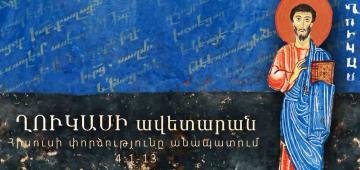 |
The Temptation of Jesus in the Desert (4:1-13)
The fourth chapter of the Gospel of Luke, verses 1-13, presents how the devil tempted Jesus in the desert for 40 days, tempting Him and offering Him three different temptations.
How does Christ remind us that we should not tempt God, and how can we ourselves, with the power of God, withstand the constant trials of our lives?
The Gospel passage is interpreted by Father Markos Mangasaryan.
|
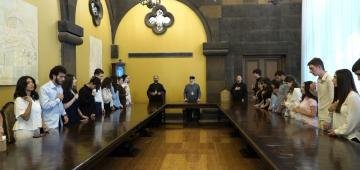 |
Catholicos of All Armenians Receives Diaspora Armenian Youth Participating in Armenology Courses
Karekin II, Catholicos of All Armenians, received about 30 young people who arrived from the Diaspora to the Mother See to participate in Armenology and religious studies courses.
The aim of the courses, which are now in their second year, is to promote the knowledge of the Armenian language and history of young people living abroad and to strengthen their connection with the spiritual and cultural heritage of the homeland.
During the meeting with the Armenian Patriarch, the young people introduced themselves and told about themselves, and His Holiness urged them to use the knowledge they have acquired to strengthen national and church life in communities around the world.
|
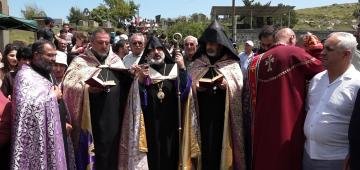 |
Vardavar in Gegharkunik
On the feast of the Transfiguration of Christ (Vardavar), a pilgrimage was organized under the leadership of the Primate of the Gegharkunik Diocese, Bishop Isahak Poghosyan, to the 11th-13th century Ishkhanavank of Vardenik, where a festive Divine Liturgy was celebrated and the rite of the Andastan was performed.
During the event, the Holy Father presented letters of blessing to the benefactors who supported the improvement of the sanctuary.
The celebration continued on the top of Mount Armaghan, next to the Church of the Holy Resurrection, where after the Divine Liturgy and the traditional sprinkling of water, national songs and dances were performed.
|
 |
Baku's demand to change the RA Constitution is not about Artsakh
Human rights activist, President of the "Artsakh Union" NGO Artak Beglaryan, when asked who is listening to the people of Artsakh today, answers: "Today there is a problem of more speakers, because the pressure on the people of Artsakh is great, unfortunately, also from the Armenian authorities." Can geopolitical and internal political tensions overshadow the Artsakh agenda to the extent that it disappears? Anna Sargsyan spoke with Artak Beglaryan.
|