 |
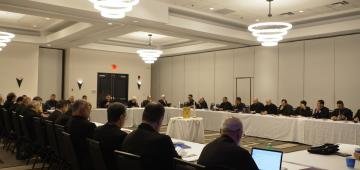
The 123rd Diocesan Assembly of Clergy and Deputies convened in the Eastern Diocese of the Norther America
The clergy of the diocese discussed the achievements of the past year, the difficulties of parish life and the challenges facing the homeland. The conference ended with a Divine Liturgy in the newly consecrated Church of the Holy Archangels, St. Gabriel and St. Michael. At the initiative of the Primate of the diocese, a social assistance program for 700 homeless people was included in the agenda of the meeting. The clergy and deputies prepared more than 700 food bags to be distributed to local shelters and charitable organizations.
|
 |
A penitential rite was performed and a Holy Liturgy was celebrated in the Diocese of BrazilThe Armenian Diocese of Brazil has been preparing for the Holy Thursday ceremonies with prayer and spiritual conversations for days. Deacon Aramayis Soghbatyan, with the blessing of the Primate of the Diocese, Archbishop Narek, conducted spiritual courses for the students of the Armenian National Durian School, introducing them to the gospel stories and their interpretations. In the second half of the day, a ceremony of Washing of the Feet was performed. |
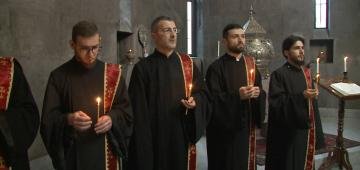 |
The celebration of Palm Sunday concludes the forty-day period of Great Lent
During the evening service on Holy Tuesday, the parable of the 10 virgins is commemorated. Holy Wednesday commemorates the anointing of Christ and the betrayal of Judas. Holy Thursday commemorates the Last Supper and the institution of the Eucharist. The ceremony of Washing of the foot is also performed on that day. After the Holy Thursday service, the Rite of the Eclipse is performed. It symbolizes the arrest, suffering, crucifixion, and death of the Lord. Good Friday commemorates the suffering, crucifixion, death, and burial of Jesus Christ. The Rite of the Crucifixion is held in the afternoon, and the Rite of the Burial in the evening. On Holy Saturday, candles and lamps will be lit in churches. On Sunday, a patriarchal liturgy will be served in the Mother Cathedral. The Catholicos of All Armenians will deliver his Easter message.
|
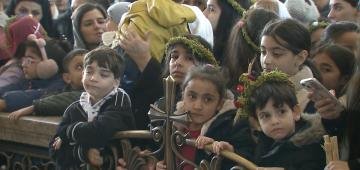 |
The Armenian Apostolic Church will celebrate Palm Sunday, the commemoration of Christ's entry into Jerusalem, on April 13
Palm Sunday is the triumphal entry of Christ into Jerusalem. It also symbolizes the entry of our Lord into the Upper Jerusalem. In this sense, Christ’s entry into Jerusalem is also called the Advent. That is why on the evening of Palm Sunday the ceremony of the Opening of the Doors is performed, which shows the example of the Advent of Christ.
Through the ceremony of the Opening of the Doors, we relive the event expected at the end of the world, when the doors of the Kingdom of God will be opened, and the righteous will enter there. The Opening of the Doors ceremony is performed in the form of a dialogue between the clergy kneeling in front of the closed tabernacle and those standing behind the curtain. In the Armenian Church, this form of question-and-answer is used only during the Opening of the Doors ceremony. The veiled altar symbolizes the Kingdom of Heaven.
|
 |
On April 7, the Armenian Apostolic Church will celebrate the Feast of the Annunciation of the Blessed Virgin MaryAt the end of the liturgy, a blessing ceremony will be held for mothers and women awaiting the joy of motherhood. The Armenian Apostolic Church will reflect on the biblical story of the Annunciation, according to which the angel Gabriel is sent by God to the city of Nazareth in Galilee and announces to Mary, the betrothed of Joseph, that she will conceive by the Holy Spirit and bear a son named Jesus, who will be called the Son of the Most High, will inherit the throne of David, and his kingdom will be eternal. |
 |
The Armenian Apostolic Church commemorates the imprisonment of the Illuminator in the Pit on April 5th.On that day, pilgrimages are organized to Armenian holy places. Usually, numerous groups of pilgrims visit Khor Virap, where Saint Gregory the Illuminator managed to survive for 14 years among snakes and scorpions through prayer and asceticism. The curtain of the church altar will be opened and an open liturgy will be served. The faithful will receive communion. |
 |
The Median Day meal has no festive significance and does not break the fast
The people celebrate Median Day with special dishes and a number of rituals. An integral part of the day is the symbolic bagharj or Median Day gata, with a hidden symbol inside. Median Day gata is also a Lenten dish. It is made with oil, honey, nuts, and raisins.
|
 |
On March 2, the Armenian Apostolic Church will celebrate the Eve of Great Lent: The start of Great Lent will be announced
Great Lent precedes the feast of the Holy Resurrection of Jesus Christ and lasts 48 days. The curtains of the tabernacle will be closed during the Liturgy on Barekendan itself and will remain closed throughout Lent; communion will not be given, except on a few feasts.
|
 |
February 25th is the commemoration day of the Saints Ghevond the Priest and His Companions and February 27th is the commemoration day of Saints Vardan the Priest and His CompanionsOn the day of remembrance of the Saints Ghevond the Priest and His Companions, the clergy of the Armenian Apostolic Church traditionally gathers in the Mother See of Holy Echmiadzin. A Divine Liturgy is served, at the end of which a priestly gathering takes place. The problems facing the clergy, as well as spiritual programs implemented in the national, family, and educational spheres, are discussed. An awards ceremony is held under the chairmanship of the Patriarch of All Armenians. A Divine Liturgy is also served on the day of remembrance of Saints Vardan the Priest and His Companions, during which a Patriarchal blessing is made. |
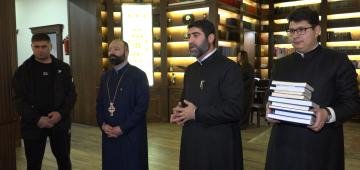 |
On Book Day, the Mother See donated nearly two hundred titles of literature to the Soldier's HouseHe donated about a hundred titles of literature from the Mother See's publications and an equal number of Armenological literature. The Soldier's House has a library, where the boys have the opportunity to get acquainted with selected contemporary world literature and find books in their field of interest. |
 |
February 15th is the feast of Saint Sarkis, his son Martiros, and 14 soldiers
Saint Sarkis the Warrior is considered the patron saint of young people. By the decree of His Holiness Karekin II, Catholicos of All Armenians, the feast has been declared a day of blessing for young people. On that day, a liturgy is served in churches named after the Saint, after which a blessing ceremony for young people is performed. The feast is also a day of naming those named Sarkis. Every year on the feast of Saint Sarkis, the Gospel, copied in the 17th century in the Saint Sarkis Church, is brought from the Matenadaran in Yerevan to the Saint Sarkis Church.
|
 |
A festive liturgy will be served in Armenian Apostolic churches on the morning of February 14
40 days after the Nativity, the Armenian Apostolic Church celebrates the feast of the Presentation of the Baby Jesus to the Temple, known as the Presentation of the Lord. The pre-feast is celebrated on the evening of February 13. At the end of the liturgy, according to folk custom, a bonfire is lit. The Presentation of the Lord is an invitation to everyone to go to meet the Lord, and to present a child to the church means to educate and train him spiritually. When Mary takes the 40-day-old Jesus to the temple, an old man named Simeon recognizes and meets Jesus. Hence the name of the feast: the Presentation of the Lord.
|